Managing Guilt When You Live Away From Your Parents
There's a particular kind of guilt that comes with living away from your parents. It doesn't announce itself loudly. It just sits quietly in the background, surfacing every time your phone rings late at night, every time a family member drops a comment about how you're never around, and every time your parents sound a little more tired than usual on a call. This is a feeling familiar to almost anyone caring for parents from abroad, and it's one of the most common emotional costs of long distance caregiving.
A recent government survey found that nearly 49% of India's elderly live only with their spouse, while just 26.5% live with their children or other family members, a clear sign that more and more ageing parents are managing daily life largely on their own. If you've moved to another city for work, settled abroad, or simply ended up far from where you grew up, this feeling probably isn't new to you. And the truth is, you're far from alone in it.
But guilt, when it's not dealt with, has a way of becoming its own problem. It clouds your thinking, it makes you reactive rather than practical, and it slowly wears you down. So rather than carrying it around quietly, it helps to actually look at it.
First, understand where the guilt is really coming from
Most long-distance children aren't guilty of neglecting their parents. What they're actually dealing with is the gap between what they wish they could do and what's realistically possible given where they live, how much they earn, and how much time they have.
That gap is real, and it does hurt. But it's worth separating out what you can genuinely control from what you can't. You can't teleport home. You can't be in two places at once. What you can do is be intentional about the support you put in place, stay genuinely connected, and make sure the right people are looking out for your parents when you're not around.
Stop measuring care by physical presence alone
A lot of the guilt that long-distance children feel comes from one idea: that being a good son or daughter means being there in person. And while visits matter, they're not the only thing that counts.
Staying in regular contact, knowing what your parents' days actually look like, understanding their health, keeping track of their medicines, making sure they have people around them, and ensuring someone can respond quickly if something goes wrong, all of this is care. It just doesn't always feel like enough because it's not visible in the way that being physically present is.
Redefining what "being there" actually means is one of the most useful shifts a long-distance child can make.
Build a reliable support system on the ground
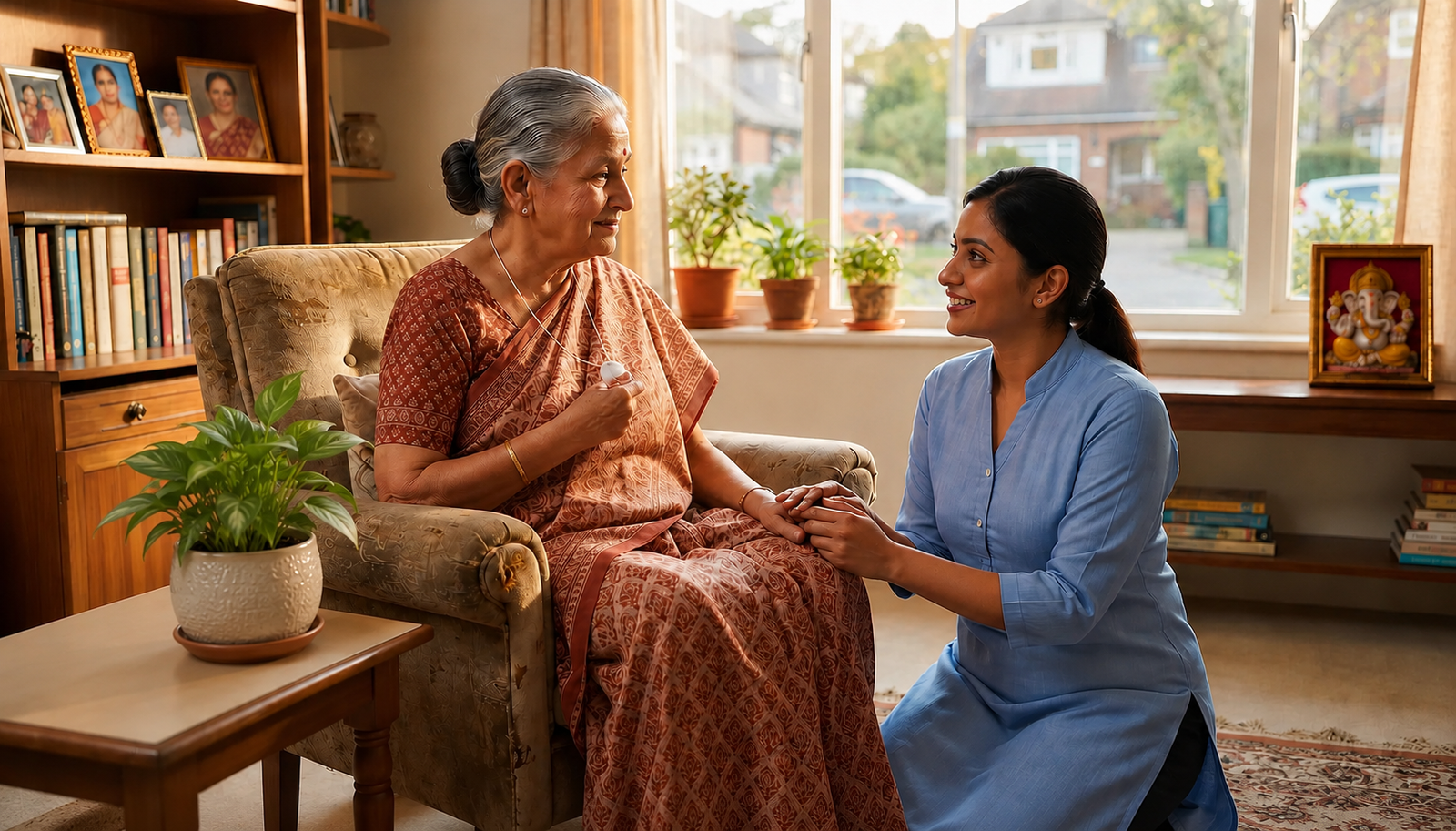
One of the most practical things you can do is stop trying to manage everything remotely on your own and instead put together a proper support system close to your parents. This could be a trusted neighbour who checks in, a local family member who keeps an eye on things, or a structured care service that provides daily oversight.
The goal is to make sure that even on the days when you can't reach your parents or something feels off, there's someone on the ground who can actually do something about it.
This is exactly what Sukoon's Physical Security service is built for daily "All is Well" check-ins, home safety oversight, and a reliable presence so that your parents are looked after on the days when you simply can't be there yourself.
Stay connected in a way that actually means something
Regular calls matter, but the quality of connection matters more than the frequency. A rushed five-minute check-in where you're half-distracted is less meaningful than a proper conversation where you're genuinely present.
Ask your parents about their day. Ask what they've been watching, who they've spoken to, how they're sleeping. Notice when something sounds different. And don't just call to check a box, call because you actually want to know how they are.
For parents who aren't very expressive on the phone, letters and voice notes sometimes work better. Small gestures that show you're thinking of them go a long way, even when the distance doesn't change.
Sort out the practical things before they become urgent
A lot of guilt spikes during a crisis, when something has gone wrong and you feel completely unprepared. The best way to reduce that kind of guilt is to get the practical things in order before you actually need them.
That means knowing which hospital your parents would go to in an emergency. It means having their medical history somewhere accessible. It means knowing who to call, what medicines they're on, and what their health looks like right now. It also means making sure someone local knows all of this too.
What Our Medical Sukoon service handles exactly this: health profiling, digital documentation, emergency preparedness, and hospital coordination, so that if something does happen, you're not starting from scratch in a panic.
Don't try to carry this alone
If you have siblings, have an honest conversation about how responsibilities are being shared. It doesn't have to be equal in every way, because different people can contribute differently based on where they live, what they earn, and what their schedule looks like. But making sure it's talked about and agreed upon takes a lot of silent resentment off the table.
And if you genuinely feel overwhelmed by the worry of it all, talking to someone helps. Caregiver guilt, especially from a distance, can build up into something heavier than it looks. It's okay to acknowledge that.
Your parents also need more than just care
Here's something that gets missed when families focus purely on the practical side of things. Your parents don't just need someone to cook for them or remind them about medicines. They need to feel like their lives still have colour in them.
When parents are left largely to themselves, days can start to feel very empty. And that emptiness affects everything, their mood, their motivation, their health, and how much they engage with the world.
Sukoon Clubbing brings seniors together through hobby groups, travel circles, community meetups, music, art, and shared experiences because staying socially engaged isn't optional. It's one of the most important parts of staying well.
What Sukoon makes possible for families like yours
Living away from your parents doesn't mean being a less caring child. It means you need smarter systems, the right people on the ground, and the reassurance that comes from knowing nothing important is being missed.
At Sukoon, we work with families where children are in other cities, other countries, and stretched thin between their own responsibilities and the worry they carry for their parents, offering parent care for NRIs and remote elder care in India that actually holds up day to day. We help put the right structure in place so that your parents are genuinely looked after, not just on paper but in practice.
Because the goal was never for you to stop living your life. It was to make sure your parents could keep living theirs, safely, comfortably, and with proper home care for elderly parents that means people genuinely looking out for them.